Every plant manager understands the frustration of "unexplained" inventory loss. It's a pervasive issue, often treated as an unavoidable cost of doing business, a mysterious drain on resources that impacts profitability and operational efficiency. But what if much of this mystery could be solved, and these losses proactively addressed rather than simply absorbed?
Recent diagnostics across various facilities have shed light on a critical, yet often overlooked, culprit: the receiving method itself. Our data consistently shows a stark difference in inventory variance between plants still relying on traditional paper receiving forms and those that have transitioned to direct input via handheld scanners. The gap isn't just noticeable; it's substantial enough to account for a significant portion of what later appears as inexplicable inventory discrepancies.
The Data Don't Lie: Unmasking the Receiving Gap#
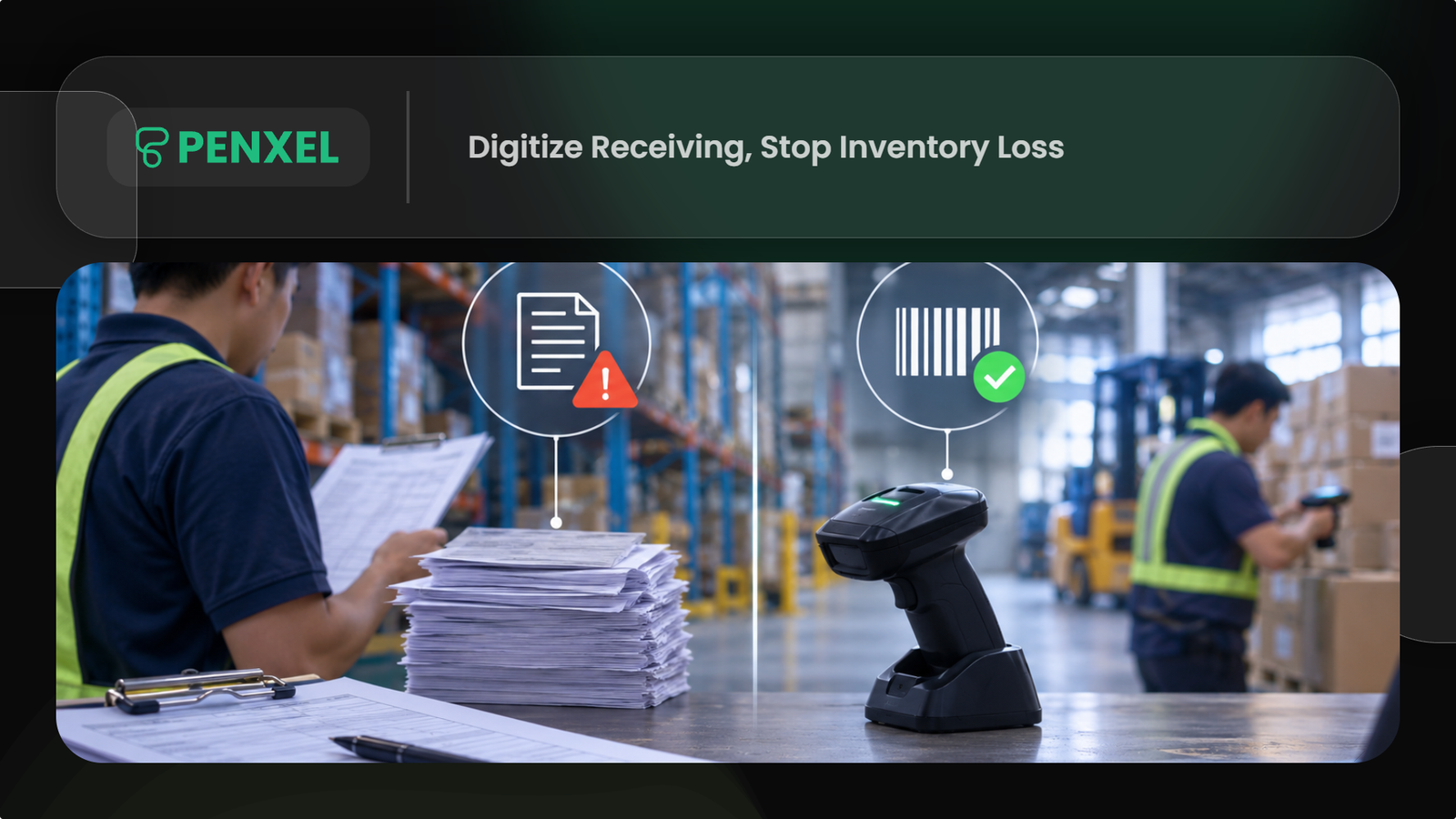
Our analysis revealed a clear, quantifiable truth: facilities utilizing paper-based receiving averaged meaningfully higher variance compared to those employing handheld scanning devices for direct data capture. This isn't a minor fluctuation; it's a systemic issue rooted in the inherent limitations of manual processes.
Why Paper Receiving Creates Variance#
Paper forms, while familiar, introduce multiple points of failure that accumulate into significant inventory discrepancies:
Manual Data Entry Errors: Each handwritten entry is susceptible to human error – misread numbers, transposed digits, or incorrect quantities. These errors then propagate through the system when transcribed into digital records.
Delays in Data Processing: Information on paper forms isn't immediately available to the inventory management system. There's a lag between physical receipt and digital update, creating a window where inventory status is inaccurate. This can lead to miscounts, mispicks, and production delays.
Legibility Issues: Illegible handwriting can lead to misinterpretation during data entry, further compounding errors.
Lack of Real-time Validation: Paper forms offer no immediate feedback or error checking. A mistake made at the receiving dock isn't caught until much later, if at all, making reconciliation difficult and time-consuming.
Double Handling of Information: Data is first written, then typed. Each step adds potential for error and inefficiency.
The Digital Advantage: Precision with Handheld Scanners#
In contrast, handheld scanners streamline the receiving process, drastically reducing variance:
Direct Data Capture: Barcode scanning eliminates manual entry, ensuring accuracy and consistency. The item and quantity are recorded precisely as they arrive.
Real-time System Updates: Data is immediately uploaded to the inventory management system, providing an accurate, up-to-the-minute view of stock levels. This minimizes discrepancies between physical and digital inventory.
Built-in Validation: Many scanning systems offer immediate feedback, alerting operators to mismatches between received items and purchase orders, preventing errors from entering the system.
Reduced Human Error: By automating data capture, the potential for human transcription errors is virtually eliminated.
Improved Traceability: Digital records provide a clear audit trail, enhancing accountability and simplifying investigations into discrepancies.
The difference in variance between these two methods is not anecdotal; it's a statistically significant gap that directly translates into lost inventory value. This finding presents a critical strategic fork in the road for plant managers heading into the 2027 budget cycle.
The Invisible Drain: How Receiving Inaccuracy Hides in Your Budget#
If inventory discrepancies are costing your operation, why isn't there a clear budget line item for "inventory inaccuracy"? The truth is, these costs are often absorbed into other, seemingly unrelated, budget categories. They are the silent, insidious drains that erode profitability without ever being explicitly named.
Consider where the financial fallout of poor receiving accuracy typically surfaces:
1. Excessive Safety Stock#
When you lack confidence in your inventory numbers, the natural defensive mechanism is to carry more safety stock. This buffer is intended to cover unexpected demand or supply chain disruptions, but it also acts as a hidden cushion for unreliable internal counts.
Tied-up Capital: Every peso in safety stock is capital that could be invested elsewhere, generating returns. Instead, it sits idle in your warehouse.
Increased Carrying Costs: More inventory means higher costs for storage, insurance, security, and potential obsolescence.
Reduced Agility: Large safety stocks can mask underlying issues and make your operations less responsive to market changes.
2. Expedited Freight and Rush Orders#
Despite carrying safety stock, inaccurate receiving can still lead to stockouts. When the system shows items are available but they aren't physically present, or when a crucial component is miscounted, production can halt. The knee-jerk reaction is often expedited freight – paying premium prices for rush delivery to avert a line stoppage or meet a critical customer order. These costs are significant and recurrent.
3. Overtime for Pre-Audit Counts#
Before a financial audit, many plants undertake extensive, often manual, pre-audit inventory counts. This is done precisely because the system's inventory figures are not trusted. This labor-intensive process demands significant overtime hours from your team, diverting them from productive tasks and incurring substantial, unplanned expenses. It's a reactive measure to compensate for a proactive failure.
4. Year-End Write-offs#
At the end of the fiscal year, accumulated discrepancies that can no longer be ignored are often written off. These write-offs, while necessary for financial reconciliation, directly impact profitability. They often get absorbed into vague "other losses" or "cost of goods sold adjustments," making it difficult to pinpoint the root cause and address it systematically.
None of these expenses typically appear under an "inventory accuracy" line item. Yet, they are all direct consequences of a failure to accurately capture inventory at the point of receipt. They represent money spent to mitigate the symptoms, rather than cure the disease.
The 2027 Budget: A Strategic Fork in the Road#
As budget season for 2027 approaches, plant managers face a clear choice:
Path A: Continue Budgeting for the Gap: Maintain current practices, accepting the need to budget for safety stock, expedited freight, overtime, and write-offs. These recurring costs will continue to silently erode profitability, year after year, without truly solving the underlying problem.
Path B: Budget Once for the Fix: Invest proactively in a digital receiving solution. This strategic allocation of funds aims to eliminate the root cause of variance, thereby removing the need for many of the hidden costs associated with inventory inaccuracy.
Choosing Path B is not merely an expense; it's an investment with a clear, measurable return. By stopping the bleeding at the source, you free up capital, reduce operational stress, improve forecasting, and enhance overall supply chain resilience. This isn't just about saving money; it's about optimizing your entire operation for greater efficiency and reliability.
Why Now? Seizing the Budget Season Opportunity#
Budget season is a critical window of opportunity. It's often the one time of year when finance genuinely asks the tough questions about expenditures and performance. Having concrete data and a clear proposal to address a systemic cost driver can be incredibly powerful.
If there's no dedicated line item for inventory accuracy in your 2027 budget, it usually means you're planning to spend the same money, or more, in less visible, less accountable places. Presenting a well-researched case for investing in receiving accuracy allows you to shift from reactive problem-solving to proactive strategic improvement. It demonstrates foresight and a commitment to operational excellence.
Your First Step Towards True Inventory Clarity: The Penxel Diagnostic#
We understand that securing budget approval for new technology can seem daunting, especially if you lack precise figures for your own operations. That's why we've designed a low-barrier, high-impact first step: the Penxel Diagnostic.
For a fixed amount of ₱10,000, we provide a focused, 5-day inventory count conducted by two trained counters. This isn't a full-scale audit; it's a targeted exercise designed to pinpoint your specific receiving variance. The output is a clear, actionable number that quantifies the impact of your current receiving method.
This diagnostic is purposefully sized to fit comfortably within a 2027 budget line item, often without requiring extensive board paper or high-level approvals. It's a small investment that yields critical data, empowering you to approach your finance team with a solid, data-backed justification for a more comprehensive solution. Furthermore, the cost of this diagnostic is creditable towards our ₱49K Starter Pack, providing a seamless pathway to a full digital receiving implementation when you're ready.
Imagine walking into budget discussions armed with a clear understanding of exactly how much your current receiving method is costing you in hidden expenses. This diagnostic provides that clarity, transforming "unexplained loss" into a quantifiable problem with a tangible solution.
Beyond Transactions: Building Relationships for Sustainable Success#
At Penxel, we believe in building relationships that extend far beyond a single transaction. Every November, we make it a point to connect with plant managers, not with a sales pitch, but simply to listen. To understand their operational realities, their challenges, and their successes throughout the year.
These