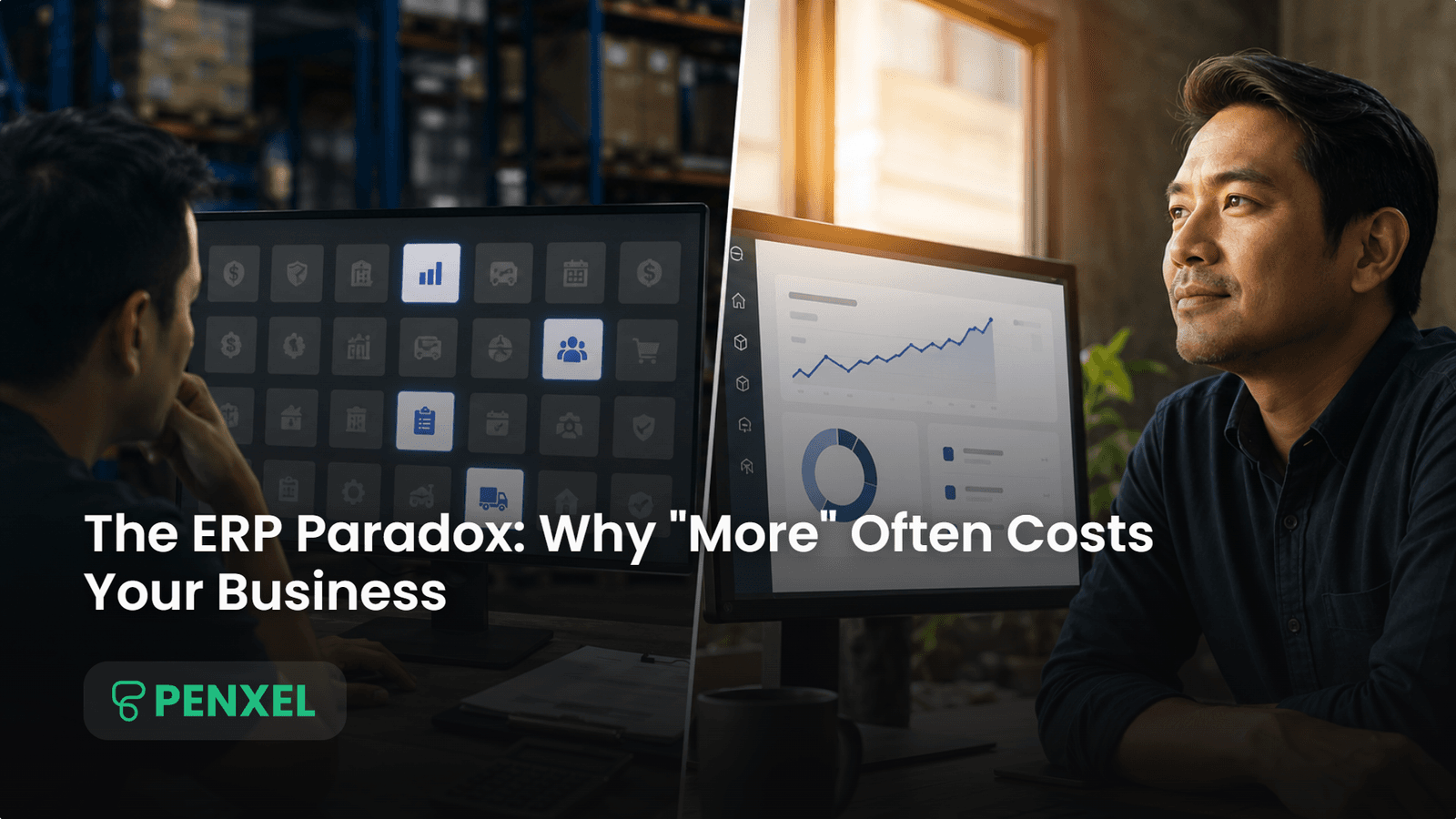
Many organizations find themselves entangled in ERP contracts that promise comprehensive solutions but deliver a stark reality: paying for a vast array of features and modules that remain untouched. This common predicament isn't merely an inefficiency; it's a significant drain on resources, perpetuating a cycle of overpayment for functionalities that fail to align with a company's actual operational footprint.
The Hidden Cost of "More" in ERP Contracts#
The traditional ERP sales model often presents an extensive suite of modules, positioning "more features" as inherent value. Businesses are frequently licensed for dozens of functionalities, from advanced supply chain optimization to complex human capital management, even when their day-to-day operations utilize only a fraction of these capabilities.
The "All-Inclusive" Illusion#
ERP vendors often bundle modules into comprehensive packages, making it challenging for businesses to select only what they need. The rationale presented is often about future-proofing or unlocking potential synergies across departments. However, for many small to medium-sized enterprises (SMEs) or even specific departments within larger corporations, this results in an immediate and continuous overspend. A manufacturing company focused on local distribution, for example, might find itself paying for global logistics and multi-currency financial consolidation modules it will never activate.
Implementation Mismatch#
The problem often deepens during the implementation phase. Vendor implementation teams, bound by the extensive scope outlined in the contract's fine print, configure the system to its full, licensed capacity rather than tailoring it precisely to the client's actual, daily workflows. This can lead to:
Over-configuration: Setting up modules and features that are not critical for current operations, consuming valuable time and resources.
Complexity bloat: Introducing unnecessary steps or data fields that complicate user adoption and increase training overhead.
Deviation from core needs: The focus shifts from solving immediate, critical business problems to simply activating all licensed components, regardless of their immediate utility.
Perpetual Maintenance Fees#
Two years into an ERP contract, it's not uncommon for businesses to be paying substantial annual maintenance fees on modules that no one on their team has opened or actively used since the initial onboarding. These fees, typically a percentage of the total software license cost, represent a continuous financial hemorrhage. They are not tied to active usage or value derived but to the initial, often inflated, licensing agreement. This translates directly into diminished ROI, as capital is tied up in supporting dormant software infrastructure.
Beyond Scale: Identifying the Wrong-Fit Problem#
The issue of overpaying for ERP isn't necessarily a "scale" problem, where a company might eventually grow into its extensive system. More often, it's a fundamental "wrong-fit" problem. The software's design, complexity, or pricing model simply does not align with the company's operational reality, current maturity, or specific strategic objectives.
Symptoms of a Wrong Fit#
Recognizing a wrong-fit ERP is crucial for mitigating its long-term impact. Key indicators include:
Low User Adoption: Employees bypass the ERP for certain tasks, reverting to manual processes or simpler tools like spreadsheets, indicating the system is either too complex, irrelevant, or cumbersome for their actual needs.
High Customization Costs for Basic Functions: Extensive and expensive customizations are required to make the system perform even basic, everyday tasks, suggesting a fundamental misalignment rather than a need for niche features.
Bloated Training Budgets: Continuous and intensive training is required for basic operations, reflecting the system's inherent complexity rather than the team's learning curve.
Focus on Workarounds: Teams spend significant time devising workarounds for the system's inefficiencies or lack of direct applicability, rather than leveraging it as an enabler.
Inability to Extract Actionable Insights: Despite vast data storage capabilities, the system fails to provide clear, relevant reports or dashboards that inform business decisions, often because the necessary data isn't being captured or processed effectively due to unused modules.
Disproportionate Support Costs: A significant portion of IT budget is allocated to supporting the ERP system, even for modules that see minimal to no active use.
The "Return to Excel" Phenomenon#
A stark symptom of a wrong-fit ERP is when businesses, after significant investment in a comprehensive system, quietly revert to using simpler tools like Microsoft Excel for critical operations. This isn't a failure of the business to adapt; it's often a failure of the software to provide pragmatic, accessible value. When the complexity of the ERP outweighs its perceived benefits for daily tasks, the path of least resistance becomes a familiar spreadsheet, undermining the very purpose of an integrated system. This often happens because the initial sales process prioritized breadth over fit, leaving the implementation team to configure a system that, while technically capable, is practically unusable for the end-users.
Rethinking ERP: The Case for Focused Solutions#
The rising awareness of the wrong-fit problem has spurred a shift towards more modular, needs-based ERP solutions. This approach champions the idea of a "Starter Pack" or a core system designed to address specific, immediate pain points, rather than attempting to be an all-encompassing, future-proof behemoth from day one.
Targeted Functionality: Solving Specific Pain Points#
Instead of deploying a full suite, a focused solution starts with the most critical functionalities. For instance, a growing e-commerce business might initially prioritize robust order fulfillment, inventory management, and customer relationship management (CRM). Rather than forcing them into a system with advanced manufacturing execution systems or intricate project accounting, a targeted solution provides exactly what they need to streamline their current operations and improve customer satisfaction.
This approach ensures that every dollar spent directly contributes to solving a recognized business challenge. It reduces the initial complexity, accelerates user adoption, and provides immediate, tangible ROI. The system becomes a tool that genuinely empowers the team, rather than an expensive, underutilized asset.
Value-Driven Pricing: Paying Only for What You Use#
The core principle of focused solutions is value-driven pricing. Companies pay only for the modules and functionalities they actively use and derive value from. This model contrasts sharply with traditional licensing, where unused modules contribute to ongoing costs.
Transparent Cost Structure: Clear pricing for distinct modules or functionalities allows businesses to budget accurately and understand exactly what they are paying for.
Reduced Initial Investment: By starting small, companies can significantly lower their upfront capital expenditure, making sophisticated ERP capabilities accessible to a wider range of businesses.
Optimized Operational Expenses: Ongoing maintenance and subscription fees are directly tied to active usage, ensuring that every recurring cost contributes to operational efficiency.
Scalability with Intent: Growing into Broader Features#
A focused solution is not a static, limited system. It is designed with modularity and scalability in mind, allowing businesses to expand their ERP capabilities as their needs evolve.
Phased Rollout: Companies can incrementally add modules—such as advanced financial reporting, HR management, or sophisticated business intelligence—when they genuinely need them, rather than being forced to pay for them upfront.
Organic Growth: This approach supports organic business growth, ensuring that the ERP system evolves in lockstep with the company's strategic roadmap, rather than dictating it.
Reduced Risk: By implementing in phases, businesses can test the utility of new modules, assess user adoption, and adjust their strategy with minimal disruption and financial risk.
Building "Honest Software": A New Paradigm#
The philosophy behind focused ERP solutions can be encapsulated as "honest software"—systems designed to meet actual needs without unnecessary bloat or hidden costs. This paradigm shift prioritizes user value and business alignment over aggressive upselling.
Transparency in Scope#
"Honest software" begins with transparent discussions about scope. Instead of pushing the most comprehensive package, vendors adopting this philosophy work to understand a client's immediate, critical needs. The goal is to define a Minimum Viable ERP (MVE) that delivers significant value quickly, with clear pathways for future expansion. This fosters trust and ensures that expectations are aligned from the outset.
Empowering the User#
At its heart, this approach empowers the end-user. Software is designed to be intuitive and directly relevant to daily tasks, reducing the learning curve and increasing adoption rates. When users perceive the system as a helpful tool rather than a burdensome obligation, productivity naturally improves. This means prioritizing user experience for the actual core functions, rather than spreading design effort thinly across dozens of rarely used features.
Long-Term Partnership#
By aligning pricing with value and offering genuine scalability, providers of "honest software" foster long-term partnerships. The relationship shifts from a transactional sale of a large, complex system to an ongoing collaboration where the ERP evolves with the client's business. This model encourages vendors to deliver continuous value, as their success is directly tied to the client's successful and expanding use of the system.
Actionable Steps for Businesses#
To avoid or remedy the wrong-fit ERP problem, businesses should adopt a proactive and critical approach to their software investments.
1. Audit Your Current ERP Usage#
Perform a thorough audit of your existing ERP system.
Module Utilization Reports: If available, check system logs for active usage of each licensed module over the last 90–180 days.
User Interviews: Ask employees which parts of the system they actually use, which they avoid, and where they still rely on spreadsheets or manual processes.
Cost-to-Usage Analysis: Compare the cost of each module against its actual usage and the operational value it provides.
Identify Workarounds: Document processes where employees export data to spreadsheets, maintain separate trackers, or manually duplicate information outside the ERP.
The objective isn't simply to find unused features. It's to understand whether the system is genuinely supporting the way the business operates.
2. Identify Your Core Operational Needs#
Once usage has been established, define the small number of processes that matter most to the business today.
Ask:
What processes consume the most time?
Where do errors and discrepancies happen most often?
Which information does management need but struggle to get?
Which manual processes are creating unnecessary cost?
What operational problems need to be solved within the next 6–12 months?
These answers should determine the software scope—not the number of modules a vendor has available.
3. Separate "Need Now" From "Might Need Later"#
Not every future requirement needs to be purchased today.
Create two categories:
Need Now:
Capabilities that directly address current operational problems and have a clear owner and measurable business outcome.
Might Need Later:
Capabilities that could become useful as the company grows, but currently have no meaningful operational requirement.
This distinction prevents businesses from paying today for a hypothetical future that may look completely different when it arrives.
4. Define a Minimum Viable ERP#
A Minimum Viable ERP (MVE) should contain only the capabilities required to create meaningful operational improvement.
The goal is not to build the smallest system possible. The goal is to build the smallest system that solves the right problems well.
A successful MVE should:
Address the company's highest-priority operational bottlenecks.
Be simple enough for the actual users to adopt.
Produce useful information for decision-makers.
Have clearly defined success measures.
Provide a practical path for adding capabilities later.
This creates a much stronger foundation than attempting to activate an entire enterprise suite from day one.
5. Measure Value Before Expanding#
After implementation, businesses should measure whether the system is actually delivering the expected improvement.
Useful measures may include:
Reduced manual data entry.
Faster order or transaction processing.
Fewer inventory discrepancies.
Shorter reporting cycles.
Higher user adoption.
Reduced spreadsheet dependency.
Lower administrative workload.
Improved visibility into operational performance.
If the core system isn't being adopted or isn't producing measurable value, adding more modules is unlikely to solve the underlying problem.
6. Expand Only When the Business Is Ready#
Once the initial system is delivering measurable value, additional functionality can be introduced deliberately.
A company may eventually need advanced financial reporting, HR management, business intelligence, procurement, manufacturing, or other capabilities. But those additions should be triggered by an actual business requirement—not simply because they were included in a package.
This creates a natural progression:
Solve the current problem → prove the value → identify the next constraint → add the capability required to solve it.
The ERP grows because the business needs it to grow, rather than forcing the business to adapt to the ERP.
The Better Question Isn't "How Much ERP Do We Need?"#
The better question is:
"What does our business actually need the system to do today?"
That question changes the entire buying process.
It shifts the conversation away from feature counts, license tiers, and theoretical future requirements and toward workflows, users, measurable outcomes, and actual business value.
A system with 40 modules isn't automatically better than one with four.
If your team uses four modules effectively and those four modules eliminate the problems costing you money every day, that can be a far better investment than a larger platform that nobody fully adopts.
The objective isn't to own more software.
It's to run the business better.
The Case for Starting Smaller#
Starting with a focused system isn't a rejection of growth. It's a more disciplined way of preparing for it.
Businesses change. Processes change. Teams change. Markets change. The system that makes sense today may not be the system required three years from now.
That is precisely why buying everything upfront can be counterproductive.
A modular approach gives the business room to learn before it commits further. It allows teams to establish good operating habits, measure results, and discover what they actually need next.
Most importantly, it keeps the technology in service of the business.
From Software Purchase to Operating Partnership#
The strongest ERP relationship isn't built around how many modules were sold.
It's built around whether the software continues to create value.
That means the vendor should be willing to ask difficult questions before recommending a package:
What are you actually trying to fix?
Who will use the system?
What does the current process look like?
What are people doing outside the system?
What result would make this investment worthwhile?
And perhaps most importantly:
Do you actually need all of this right now?
A vendor willing to answer that last question honestly is thinking beyond the initial sale.
They're thinking about whether the customer will still be successful with the system years after implementation.
Conclusion: Fit Before Scale#
The ERP market has spent years equating comprehensiveness with value.
But more software doesn't automatically create more value.
For many businesses, the real opportunity is the opposite: fewer unnecessary modules, simpler workflows, stronger adoption, clearer reporting, and pricing that reflects actual use.
The goal shouldn't be to implement the biggest system a business can afford.
It should be to implement the right system for the business it actually is.
Start with the critical workflows.
Measure the result.
Build from there.
Because the best ERP isn't the one with the most features.
It's the one your people actually use—and that makes the business measurably better.